Our Electromagnetic Environment

Our Electromagnetic Environment |
The universe at large is permeated by electromagnetic energy including light, radio waves, gamma rays, and electric and magnetic fields. Stars are nuclear fusion furnaces which radiate electromagnetic energy in every conceiveable form, plus subatomic and charged particles. Two of the hottest topics in the exploration of the universe are Magnetars and Gamma Ray Bursts.
Magnetars are extremely compact stars that have magnetic fields exceeding 1000 trillion Gauss, compared to the Earth's magnetic field of 0.6 Gauss. About ten of these are known or suspected to exist in the universe. Spinning Magnetars can create enormous bursts of energy, on Aug. 27, 1998, such an outburst ionized as much of the Earth's outer atmosphere as the sun would at high noon.
Recent investigation of Gamma Ray Bursts (GRBs) reveals these mysterious outbursts of extreme energy are scattered in ancient and remote reaches of the universe, yet they are far more intense than even magnetars. We have no idea when or how intense these bursts could be, or even if entire species could be wiped out by a rogue burst of cosmic energy.
Our galaxy, The Milky Way, has a local magnetic field of about 0.00001 Gauss, and clouds of interstellar molecules have a field of about 0.001 Gauss. Although weaker than the Earth's field, the total of this field over the vast volume of space amounts to a sum of energy that puzzles astrophysicists trying to decipher the origin and fate of the universe.
LEARN MORE at Dr Miller, University of Maryland LEARN MORE at NASA Goddard Space Flight Center LEARN MORE at Neutron Star Theory Group at UNAMThe Sun is a nuclear fusion furnace which radiates our planet with electromagnetic energy including heat, light, ultraviolet radiation, x-rays, and subatomic and charged particles. The electromagnetic environment of our planet is normally dominated by the Sun. The solar wind blows outward from the sun as a very hot but very thin gas, almost a total vacuum compared to the air we breathe, but at a temperature of more than a million degrees and moving at 1 to 2 million mph. As it expands outward the solar wind slows and cools until about 4 or 5 time farther than our last planet it slows to subsonic speed, forming a shock wave called the termination shock.

Likewise the interstellar winds impacting on the magnetic field of the sun create a bow shock. Between the bow shock from the outside and the termination shock from within, a sheath of particles called the heliopause forms an invisible cocoon around our own sun and all its planets.

Withing the next few years we hope this layer between our own solar system as interstellar space will be reached by Voyager 1 and Voyager 2 as they continue their 25 year journey outward into interstellar space.
Our sun's electromagnetic environment fluctuates constantly in cycles of 27 days, 11 years, and 22 years, along with abrupt and unpredictable disturbances including solar flares, magnetic storms, and Coronal Mass Ejections, all of which lash at the Earth. It's a rough environment 'out there!' We are now in Solar Cycle 23 which began in May 1996, is at its peak 1999 thru 2002, and is expected to end sometime around 2007. The suns surface magnetic field ranges from 1 to 5 Gauss, but sunspot eruptions bring fields in excess of 1000 Gauss to its surface, accompanied by electromagnetic waves from infrared to Xrays. Sunspots and solar eruptions are much more common during the peak years of Solar Cycles.
|
|
|
|
|
|
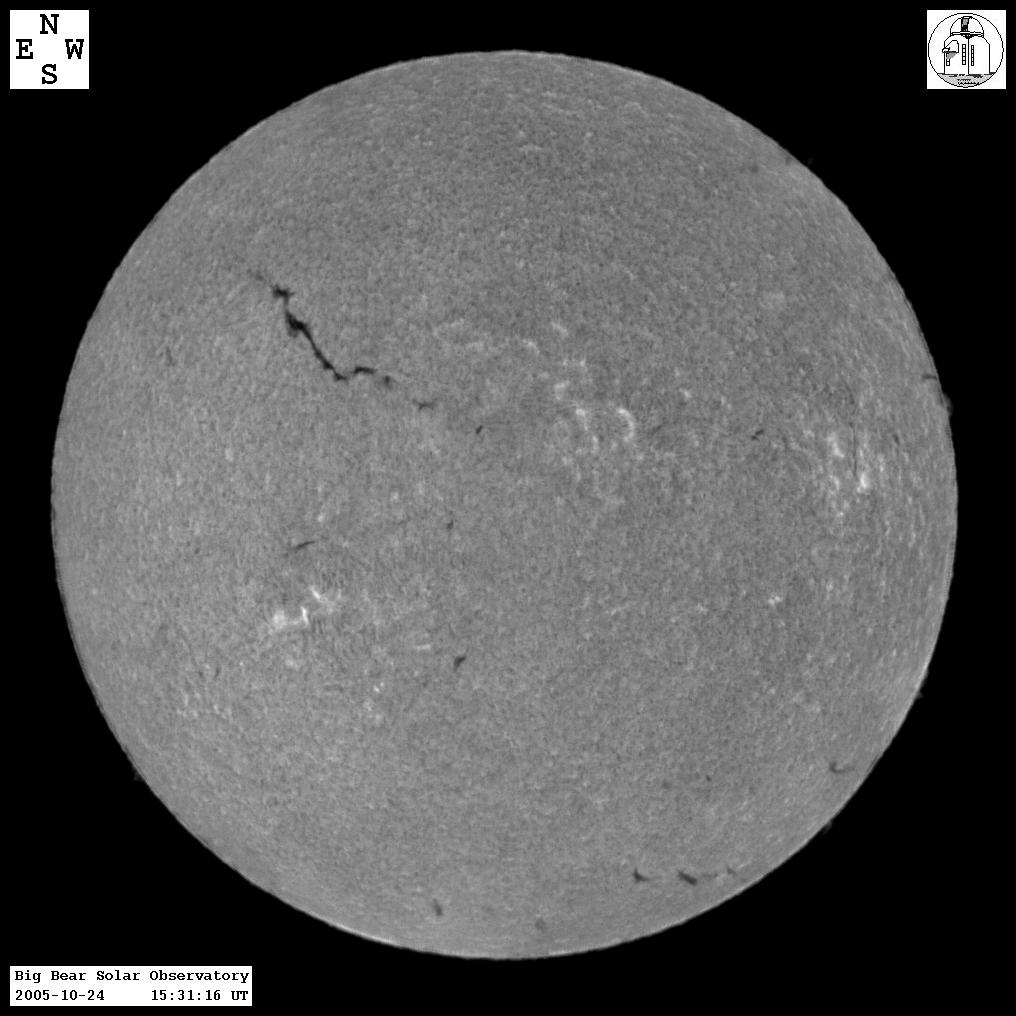
White Light |
H-Alpha |
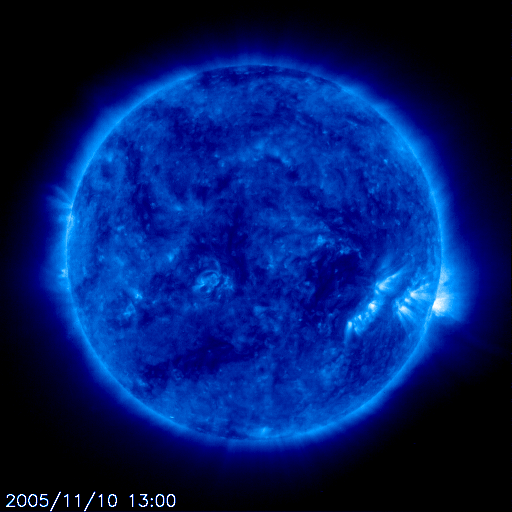
EUV-171 |
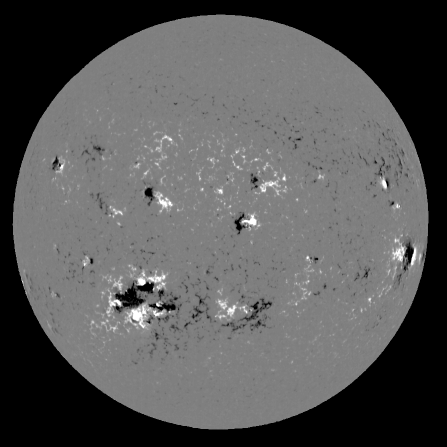
Magnetogram |
These four (and more) real time images of the sun from Stanford U Solar Center are imaged in different parts of the electromagnetic spectrum. Click image for a larger view of this hour's sunspots, flares and coronal holes.

When this energy from the sun arrives at Earth as 'solar wind' it interacts with our planetary magnetic field and our atmosphere to create a magnetically confined plasma which partially shields the fragile life on Earth surface from the harsh electromagnetic environment in space. Solar disturbances slamming against this shield at upwards of a million miles per hour play havoc with shortwave radio, cause magnetic storms and circulating electrical currents in the ionosphere and the Earth, polar aurora, and other phenomena.

The Earths magnetic field alone would look like a donut with the earth sitting in the hole. But the solar wind compresses the field on the daytime side, and blows the field far downstream on the night side. Current enters Earth's polar regions at the nothern and Southern cusps of the field.
|
|
|
 Northern Polar Aurora |
 Southern Polar Aurora |
|
These plots show the current extent and position of the auroral oval at each pole, extrapolated from measurements taken during the most recent polar pass of the NOAA POES satellite. "Center time" is the calculated time halfway through the satellite's pass over the pole. Courtesy of NOAA Space Environment Center |
|
X-ray and Ultraviolet (UV) radiation from the sun interacts with our planetary atmosphere to create the Ionosphere at altitudes between 70 km and 600 km (230,000 feet to 2,000,000 feet). Radiation causes electrons to be stripped from their atoms, leaving a mixture of positively charged ions and free negative electrons. These eventually recombine, but while they are separated they give the Ionosphere properties which cause it to absorb some wavelengths of electromagnetic energy, and to bend or reflect other wavelengths. Refraction in the ionosphere makes possible the propagation of certain radio bands over global distances.
The ionosphere, first predicted by Kennely and Heaviside, was called the Kennely-Heaviside Layer, or sometimes the E-layer due to its unique electrical properties. When other layers were discovered, they were named alphabetically in order of altitude :
| Layer | Altitude (mi) | Properties |
| D | 40 to 60 | Refracts VLF and LF, absorbs HF radio waves in the daytime |
| E | 60 to 70 | Refracts HF and sometimes VHF radio waves in daytime |
| Es | 60 to 70 | "Sporadic E" occasionally permits VHF and even UHF radio propagation |
| F1 | 120 to 160 | Refracts HF radio waves (shortwave), F1 and F2 recombine at night |
| F2 | 180 to 300 | Splits off of F layer during daytime, important for HF radio (shortwave) propagation |
These layers provide extra shielding for fragile life on Earth surface from the harsh electromagnetic environment in space. Solar flares, magnetic storms and other disturbances to the ionosphere play havoc with shortwave radio, cause polar aurora, circulating electrical currents in the Earth, and other phenomena.
See a movie simulation (3.1 MB .mpg file) of the ionosphere during the solar storm of March 20 - 21, 1990. View is looking down onto the North pole, sun is towards the top, night side is at bottom.
Clouds are generally more or less electrified. In thunderstorms, mechanical, thermodynamical, and maybe chemical energy is transformed into electrical energy (generator) with separate poles. Most thunderstorms have during their lifetime (phases: development 10-20 min, mature 15-30 min, decay 30 min) a positive charge center above and a negative one below, probably another positive one near the base. Electrification occurs in periods of 10s of minutes and spaces of about 1 km3, and there may be several such centers in a cloud. Thunderclouds mostly reach beyond freezing level, in moderate lattitudes 3 - 10 km, in the tropics often up to 16 - 20 km, seldom more. 1000 to 2000 thunderstorms are active at any time. Updrafts in storms up to 30 m/s. Total water content 1e8 to 1e9 kg. Total energy 1e15 J, electrical energy 1e12 to 1e13 J. Electrical potential vs ground at negative and positive charge centers: minus and plus 10 - 100 MV, resp.; field strength data unreliable. Electrical resistance of an atmospheric vertical column of 50 km2 cross section: several 100 MOhm between ground and negative center, negative and positive center, positive center and ionosphere. Total current flowong upward towards ionosphere derived from (data still insufficient) measurements of current densities: 0.5 - 2 A per thunderstorm cell. Current below cloud carried by conduction by fair weather ions, conduction by corona ions, convection by vertical winds, precipitation, and lightning. Electrical field strength at ground under storm; varying in strength and polarity, often 10 kV/m and more.
Terrestrial lightning, during its lifetime of up to a second, undergoes numerous variations and all its parameters change by orders of magnitude in these. (In terrestrial lightning,) we find at least four classification criteria, which taken together, give a great number of differences: intercloud, intracloud, and cloud-to-ground discharges and combinations of these; short high-current and long low-current flashes; lightnings beginning in the cloud and moving towards ground, and lightnings moving upward; lightnings lowering positive and lightnings lowering negative charges, and those doing first one and then the other. The usual cloud-to-ground lightning begins with a stepped leader of low luminosity, probably a meter or so in diameter, followed by a return stroke with a diameter in the order of centimeters, temperatures of about 30,000 K, and pressures of up to a MN/m2. After this, a dart leader may again move downwards causing a second return stroke. This may repeat several times (multiple stroke flash).
Typical voltage drop in ground or other conductors after lightning impact in the neighborhood: 10 kV/m (dangerous!) Energy delivered to a stroke about 100 kJ/m. Intracloud lightnings observed with up to 100 km length. There are probably 100 lightnings occurring on Earth at any time. Lightning frequency over oceans only about 1/10 from that over continents. Diurnal variations on continents show maximum in late afternoon and early evening, over oceans late evening until after midnight.
Ball lightning is a rare anomaly manifested as a metastable nearly spherical plasma, usually initiated by a terrestrial lightning stroke. Ball lightning has been observed at or near the earth's surface, aboard ships, and aboard aircraft in flight. A metastable plasma state has important scientific and practical implications, but has proved particularly difficult to reproduce in controlled conditions. Most attempts involve high voltage discharges or Tesla coils, although ball lightning has been reported in relatively low voltage, high current accidents such as in the battery compartment aboard a submarine and in high current switch gear.
Electrical discharges also occur from thunderstorm tops upwards to extreme altitudes. Much larger and faster than familiar terrestrial lightning, upwards lightning is more difficult to observe. The first picture of a sprite was accidentally obtained in 1989, although for at least 30 years prior there were scattered reports by pilots at high altitudes, and apocryphal reports preceeding that by a century or more. Nobel Laureate C.T.R. Wilson, inventor of the atomic cloud chamber, in his 1925 treatise on Thundercloud Electric Field Theory, predicted upwards lightning:
Some speculate that upwards lightning may be the excitation mechanism for whistler-mode sferics. There seems to be correlation of sprites with VLF through HF and VHF radio emissions but data are still sketchy.

 |
Altair Home
atmoelec.html, © July 1999 Altair. EMail altair@altair.org |